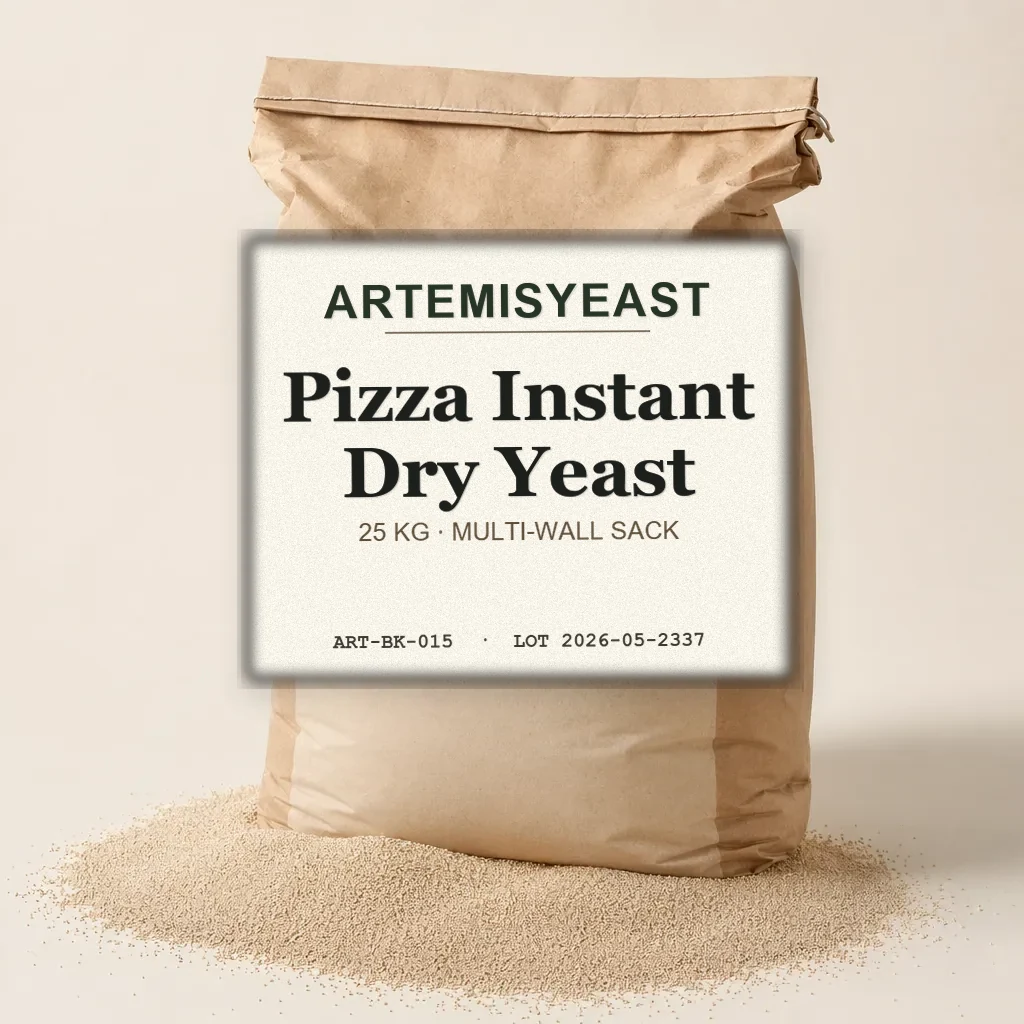
Instant Dry Yeast for Pizzeria and Frozen-Dough Lines: Dose on Flour, Storage, Cold and Frozen Dough
A pizzeria chain, commissary or frozen-dough line that changes yeast form or supplier without changing its schedule gets flat bases within a week and blames the new sack; the cost is binned batches and a line that waits, and the cause is almost always the schedule. This page is for the buyer who orders yeast by the 25 kg sack for pizza bases, flatbread or frozen crust blanks.
- ✓ Free worldwide shipping
- ✓ ISO-aligned manufacturing
- ✓ Certificate of Analysis on request
- ✓ Bulk & custom volumes quoted on request
What the yeast decision is worth
Flavour is the first gain: the same dough baked the same day reaches the same volume and texture as one fermented cold for 18-24 hours, but has almost no flavour, so a chilled hold is a quality decision before it is a yeast decision. Yeast cost is the second: a long fermentation needs less yeast, down to none at all on the longest, and more is used only when the dough has to rise quickly. Handling is the third: professional bakers favour fresh yeast, while dry yeast wins on ease of use and longer storage, and liquid yeast is mostly a large-bakery format. Labour is the fourth: dough made once and frozen is baked through the week, and balls from a three-day dough that were frozen and used a couple of weeks later baked just as well.
Dose as a percentage on flour
Flour is always 100%, whether the mix is 250 g for one small loaf or 2 tons in a bread factory, so each dose below is grams of yeast against grams of flour and scales directly. A 3 day cold pizza dough takes 1 gram of active dry yeast for its whole flour charge, rests 8-10 hours at room temperature and then 2 full days in the fridge, and is divided into 240 gram portions. A freeze-and-bake roll dough takes 5 g of instant dry yeast on 400 g of bread flour. A pizzeria poolish method puts 5 g of yeast into a poolish of 300 g flour and 300 ml water, then adds 300 g flour and 10 g salt, and manages yeast share, time and temperature as one decision. On flour, those doses are 0.2% (the cold dough's flour charge is 500 g), 1.25% and about 0.8%.
That spread is the point: cold time replaces yeast. A baker who cold-ferments 18-24 hours finishes with a final proof at 90-100 F for 2-3 hours, a step a same-day dough has no room for. Fix the schedule first (same-day, chilled one to three days, or frozen) and set the dose second; a line that moves from a three-day cold hold to same-day needs the dose up, not a different product. The same grade also runs on industrial bread lines (pan bread, buns, rolls, flatbreads and lean doughs), dosed dry with the flour at automated scaling.
Cold and frozen dough
Cold-held dough needs covered trays with little headspace: a three-day dough left in a large bowl with too much air crusted on top. On the same method, a strong professional pizza flour was the deciding factor in the result, so a yeast trial is run on your own flour, not a reference one. For frozen dough, the working practice is to freeze before the final proof and thaw overnight in the refrigerator, which doubles as a cold ferment; a sandwich franchise receives its dough portioned and frozen unproofed for that reason, so it proofs as it thaws and cannot overproof. Baking straight from frozen is the usual mistake: the crust takes too much heat before the core has thawed. Dedicated frozen-dough yeast exists to hold volume, fermentation power and proofing performance after freezing and thawing. The other route is to part-bake, cool and freeze, then finish the bake later. A raw frozen line therefore specifies the frozen-dough grade and the freeze point before final proof, and a chilled line the chilled-dough grade and its cold-hold time.
The opened sack
Bakers who buy dry yeast in bulk keep sealed packs on the shelf and only the opened one in the freezer, dosing straight from it. Dry yeast stored frozen is reported to need days in the fridge to wake fully, and a lot written off after a 10 minute proof check turned out to be alive at 20, so the check runs the full 20 minutes. A 2 lb pack is proof-checked on arrival, not at the first bad batch. Reports on how long an opened pack lasts run from weeks in a fridge to years in a freezer; they are single users' accounts, not a specification. For a plant that means logging the opening date, resealing, holding the sack cold and proof-checking every lot.
Fresh, instant, active dry and semi-dry: what to specify
All commercial baker's yeast is one species, and the three forms a buyer meets are fresh, instant dry and active dry. The dry forms in the table ship as a 25 kg multi-wall sack.
| Form | SKU | Into the dough | Where it fits | What to specify |
|---|---|---|---|---|
| Pizza instant dry yeast | ART-BK-015 | Dry, straight into the flour | Same-day dough and short chilled holds | Dose on flour, salt contact at the mixer |
| Instant dry yeast for pizza and flatbread | ART-BK-051 | Dry, straight into the flour | Flatbread with short proofs | Proof time against your present schedule |
| Instant dry yeast for chilled dough | ART-BK-024 | Dry, straight into the flour | Dough balls held cold for a day or more | Cold-hold time in the trial |
| Instant dry yeast for frozen dough | ART-BK-045 | Dry, straight into the flour | Frozen crust blanks and dough balls | Freeze point and thaw protocol |
| Semi-dry yeast | ART-BK-063 | Ask us for the handling step | Lines that want a form between fresh and dry | Storage temperature on your site |
| Active dry yeast | ART-BK-001 | Dissolved first; 92-94% dry matter, 5x10^10 CFU/g | Plants that already dissolve their yeast | Water temperature at rehydration |
| Fresh yeast | ART-BK-036 | Crumbled into the mix | Sites with frequent deliveries and cold storage | Delivery frequency |
When a batch does not rise: diagnosis in order
- The lot. Old yeast and dead yeast are the first two of six documented reasons a dough did not rise; run the proof check before anything else.
- The form against the mixing step. Instant yeast goes dry into the flour; active dry yeast is coated and has to be dissolved first, and active dry tipped dry into the flour is the classic pizza dough that fails to rise. A line that switches from active dry to instant removes the rehydration step, and the reverse adds one.
- Water temperature. Liquid that is too cold or too hot when the yeast is dissolved is the next reason, and the best water temperature is among the first things a new user asks, so it belongs on the mix sheet, not in the operator's head.
- Salt and sugar. Salt in direct contact can kill the yeast, and a dough with no sugar gives it nothing to feed on; check the dosing order at the mixer.
- Time and dough temperature. Impatience is the remaining reason: a dough that showed nothing after half an hour in a cool room rose once it was moved somewhere warmer, and the standard rescue is an oven warmed to 50 degrees Celsius and switched off. Measure the proofing room before blaming the sack.
- The clock against the form. Fresh yeast is faster even after dry yeast has been rehydrated, so a dry-yeast dough run on a fresh-yeast timetable is under-proofed and wrongly judged inferior. The same thing happens in reverse when instant yeast replaces active dry in a long-rise recipe and nobody knows how much time the swap removes. Move the schedule, not the sack, and bench-test each form once before the line changes over.
- Only then the grade. Change it from the table and bench-test it on your own flour and schedule.
Figures this page leaves to the email reply
Four figures are not documented well enough to print: a plant-scale dose range for each dough type, the conversion factor between fresh, instant and active dry yeast, the shelf life of a sealed and an opened sack, and freeze-tolerance data for the frozen-dough grade; we give them per grade by email.
Quality and Documentation
ART-BK-015 is supplied for food manufacturing use with lot traceability and batch documentation. A typical quality file may include certificate of analysis, product specification, allergen statement, non-GMO status statement where applicable, food-grade declaration, material safety information, and export documents required for the destination market. HACCP-aligned manufacturing information and food-safety certification documents such as ISO 22000, FSSC 22000, Halal, or Kosher can be provided when available for the relevant production lot and origin.
Incoming inspection parameters commonly reviewed by buyers include appearance, odor, moisture, fermentation activity, microbiological limits, net weight, packaging integrity, and pallet condition. ArtemisYeast supports procurement teams with specification matching, sample coordination where feasible, and documentation review before purchase order release. For supplier approval, visit our quality and documentation page or request the current specification sheet for SKU ART-BK-015.
Next step
Email us a three-line brief and we reply with the grade to trial, a starting dose on flour and a sample plan. Line one: dough type (same-day, chilled or frozen) and flour; line two: your schedule and proof temperature; line three: the yeast form and percentage you run now.
About this product
Do you offer documentation (CoA, food-grade declaration)?
What is the minimum order quantity?
Is bulk pricing available?
How is this product shipped internationally?
More from Baking Yeast
High-Activity Active Dry Yeast for Industrial Baking
High-activity active dry yeast (ADY) for industrial bread and bakery production. 92-94% dry matter, 5x10^10 CFU/g, neutr…
Bread Emulsifier for Industrial Baking and Frozen Dough
Wholesale bread emulsifier for industrial, artisan, and chain bakery operations. Inquiry-priced bulk.
Instant Dry Yeast for Chilled Dough, 25 kg Sack
Wholesale instant dry yeast for chilled dough for industrial, artisan, and chain bakery operations. Inquiry-priced bulk.
Concentrated Bread Improver for Bulk Bakery Use
Wholesale concentrated bread improver for industrial, artisan, and chain bakery operations. Inquiry-priced bulk.
Request a Custom Quote
We have received your message. We will reply by email.