Active Dry vs Instant Dry Yeast: Industrial Buyer Guide
Active dry vs instant dry yeast is a sourcing decision between two shelf-stable baker’s yeasts with different hydration, dosing, and process requirements. For industrial bakeries, the right choice affects fermentation speed, mixer loading, labor steps, inventory space, and consistency across lines. This guide helps procurement managers, plant managers, R&D bakers, and quality teams evaluate ADY and IDY for pan bread, buns, pizza bases, sweet dough, frozen dough, and dry mix systems. ArtemisYeast supplies bulk yeast for commercial baking programs and supports technical comparisons, documentation, and wholesale pricing on request.
Need a quote or specifications? Email info@artemisyeast.com or use the quote form — our team replies within one business day with availability, documentation, and bulk pricing.
What this category/application covers
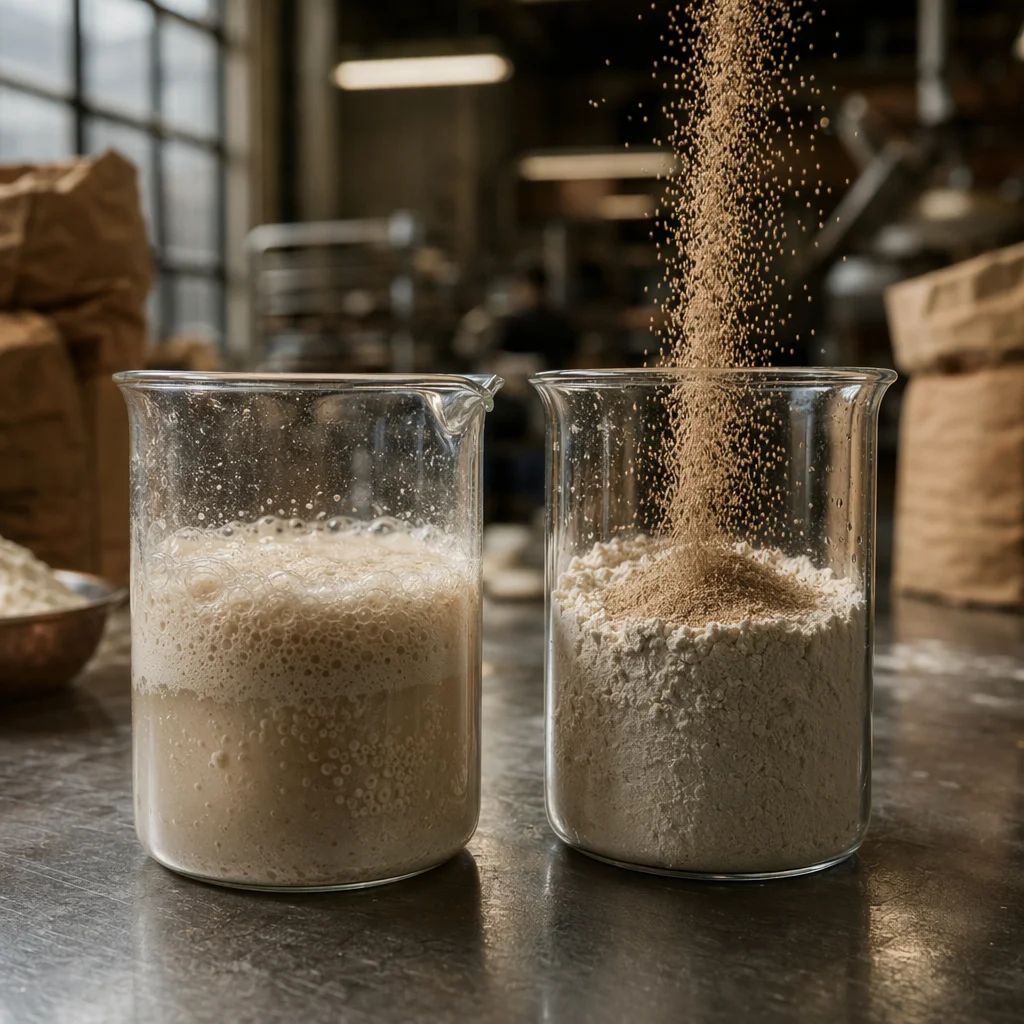
Active dry yeast, commonly abbreviated ADY, is a dried baker’s yeast that is typically rehydrated before addition to dough. Instant dry yeast, commonly abbreviated IDY, is a finer, more porous dried yeast designed for direct addition to flour or dry ingredients in many industrial processes. Both are used to produce carbon dioxide and fermentation flavor in bakery systems, but they are not identical in handling or performance.
For procurement teams, the choice is rarely only about unit price. ADY may fit operations that already use controlled hydration tanks or prefer a traditional activation step. IDY often supports simpler dosing, shorter make-up time, and easier integration into automated ingredient systems. Explore broader bakery sourcing options at bakery yeast categories or review use cases for high-throughput lines at industrial baking applications.
Common products and formulations
- Standard active dry yeast: suited to lean and moderately enriched doughs where a hydration step is acceptable and water temperature can be controlled.
- Standard instant dry yeast: designed for direct addition to dry ingredients, frequently selected for pan bread, buns, rolls, pizza, and continuous mixing systems.
- High-sugar instant dry yeast: formulated for sweet doughs where osmotic pressure can slow conventional yeast performance.
- Low-sugar or lean-dough IDY: selected for baguettes, flatbreads, pizza bases, and other formulas with lower sugar levels.
- Vacuum-packed dry yeast: commonly specified for long-distance logistics, export programs, and central warehouse supply.
- Private-label or specification-matched yeast: available for buyers who require defined pack sizes, labeling, pallet configuration, or recurring container programs through bulk yeast products.
How to choose
Begin with your process map. If your bakery has reliable warm-water hydration, trained operators, and a batch system that allows pre-activation time, ADY can be practical. If your line prioritizes dry blending, automated minor-ingredient dosing, fast changeovers, and fewer manual steps, IDY is usually easier to standardize.
| Decision factor | Active dry yeast | Instant dry yeast |
|---|---|---|
| Typical addition method | Rehydrate before mixing for best performance | Add directly to flour or dry blend in many formulas |
| Particle structure | Larger granules, slower dispersion | Finer granules, faster dispersion |
| Process fit | Batch operations with hydration control | Automated, high-speed, or dry-mix operations |
| Conversion guidance | Often used at a higher inclusion rate | Often dosed lower than ADY; confirm by bake trials |
| Labor impact | Requires an extra preparation step | Reduces handling and activation steps |
| Risk point | Incorrect hydration temperature can reduce activity | Poor distribution in dry blend can cause uneven proofing |
| Best evaluation method | Hydration control plus proof-time testing | Mixer distribution, proof time, and finished volume testing |
For formulation conversion, do not replace one type by weight without validation. Many bakeries trial IDY at a lower dose than ADY, then adjust based on proof time, oven spring, crumb structure, and flavor target. R&D should also test water absorption, dough temperature, sugar level, salt level, fat level, freezing cycle, and improver system. For a specification-based comparison or trial plan, request support through custom quote review.
Quality and documentation
Bulk buyers should define yeast specifications before negotiating annual supply. Key items include viable activity, moisture range, packaging oxygen control, shelf-life expectation, storage temperature, allergen statement, ingredient declaration, country-of-origin documentation, lot coding, certificate of analysis availability, and food safety certifications relevant to the destination market.
For IDY, ask how the product performs after long storage and whether the pack format protects activity during ocean freight or regional warehousing. For ADY, confirm recommended hydration temperature, hydration time, and tolerance to plant water quality. In both cases, maintain first-in-first-out stock rotation and avoid prolonged exposure to heat and humidity after opening. ArtemisYeast can provide documentation packages for approved buyers through the quality and documentation process.
Why work with ArtemisYeast
- Independent sourcing support: We help buyers compare ADY and IDY based on operational fit rather than a single default grade.
- Bulk-focused supply: Pack sizes, pallet plans, and shipment quantities are aligned with commercial bakeries, distributors, and food manufacturers.
- Application-aware guidance: We discuss dough type, mixer type, proofing method, sugar level, and storage route before recommending a product.
- Documentation-ready service: Procurement and quality teams can request specifications, COA formats, labeling details, and logistics information for supplier approval.
- Inquiry-only pricing: Wholesale pricing on request keeps quotations aligned with volume, packaging, destination, and contract terms.
To compare active dry vs instant dry yeast for your bakery, send your target application, annual volume, pack preference, and destination market through request a quote. ArtemisYeast will respond with suitable options, documentation availability, and a bulk quote on request.
Common questions
Is instant dry yeast always better than active dry yeast?
Can ADY and IDY be substituted one-for-one?
Which yeast is better for sweet dough?
Does instant dry yeast need warm water activation?
What should procurement request before approving a dry yeast supplier?
Which yeast type is better for dry mixes?
How should bulk dry yeast be stored?
Questions about active dry vs instant dry yeast?
Our team can recommend specific products and share documentation tailored to your application.